
Allergen Labelling Red Flags When a Value Line Is Being Quoted
The warning signs that matter on a value fragrance line are rarely dramatic. Nobody quotes a price that visibly breaches a regulation; instead, the allergen question is answered with something adjacent to an answer, and the brand only discovers the gap when the artwork is already printed. Reading the quotation stage as a compliance test, not just a price test, is the cheapest piece of risk management available to a small brand. A supplier that cannot describe the declarable substances in a compound before the order is unlikely to produce that information cheerfully after it.
Key takeaways
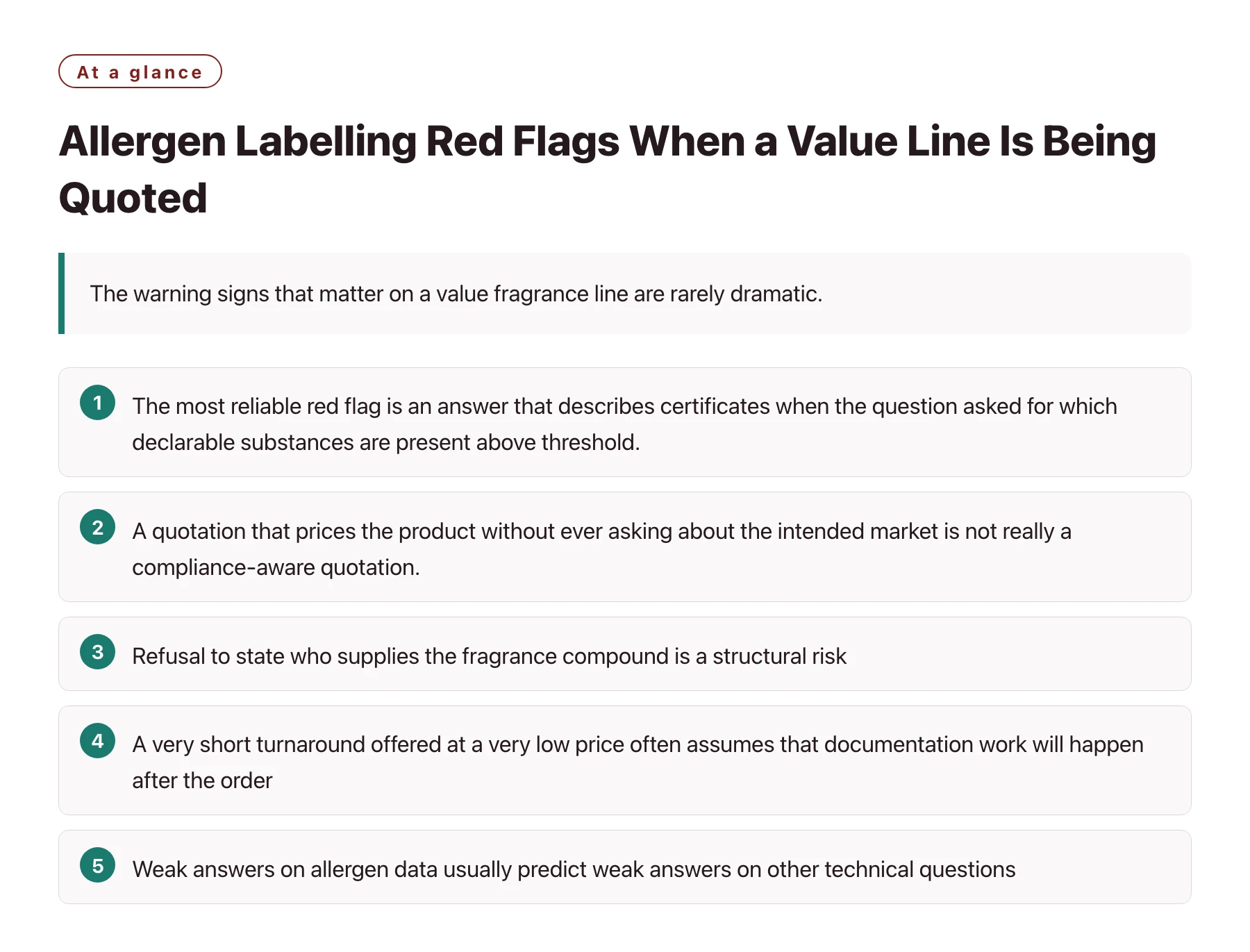
- The most reliable red flag is an answer that describes certificates when the question asked for which declarable substances are present above threshold.
- A quotation that prices the product without ever asking about the intended market is not really a compliance-aware quotation.
- Refusal to state who supplies the fragrance compound is a structural risk, because that supplier controls the allergen data the brand needs.
- A very short turnaround offered at a very low price often assumes that documentation work will happen after the order, which is exactly when it becomes expensive.
- Weak answers on allergen data usually predict weak answers on other technical questions, so the signal is worth generalising.
Value lines attract a particular kind of sourcing conversation. The volumes are modest, the price expectation is sharp, and both sides want to keep the process short. That pressure is precisely what makes allergen labelling a useful lens: it is a question with a factual answer, it cannot be bluffed for long, and the quality of the response reveals how the supplier manages information in general.
Regulation (EU) 2023/1545 expanded the list of fragrance allergens requiring on-pack disclosure and set deadlines for placing products on the EU market and for making existing stock available [1]. The practical consequence for a buyer is that the allergen question is now a live one for every fragrance product sold into that market, including entry-price ranges that were previously sold with a very short ingredient list.
The signal is usually a missing answer, not a wrong one
It is rare for a supplier to state a false allergen position. It is common for the question to be deflected into a neighbouring topic: the factory holds this certification, the compound comes from a reputable house, the product has been sold in Europe for years. Each of those may be true and none of them answers the question, which is which declarable substances are present above the applicable threshold in this specific compound.
The deflection is not always dishonest. Many factories genuinely do not hold composition data for compounds they buy in, and their answer reflects what they have rather than a decision to conceal. The distinction matters, because a supplier that does not hold the data but knows who does is a workable partner, while a supplier that cannot name the source at all is not. The European Commission's own material on cosmetic safety requirements is a reasonable primer for what a buyer is entitled to ask about [2].
One more layer: allergen restrictions and labelling are not the same question. Whether a material may be used at all is a formulation matter governed by industry standards, while whether it must be declared is a labelling matter. A supplier that conflates the two is telling the buyer that nobody has separated those files.
Six signals and what they usually mean
| Signal in the conversation | What it often means | What to ask next |
|---|---|---|
| The answer is a list of certificates | The declarable substance data has not been assembled for this compound | Ask which substances are above threshold, in writing, with the sample |
| The compound source is described vaguely | The factory buys finished compounds and does not control the data | Ask who issues the technical data sheet and whether the brand can contact them |
| No question about the target market | The quotation is priced on production alone, not on market requirements | Ask how the ingredient list changes between the EU and other markets |
| Ingredient names look like marketing copy | Nomenclature has been taken from a brief rather than a technical file | Ask for the ingredient list in recognised cosmetic nomenclature |
| A guarantee that the label is fine | The supplier is answering a legal question it is not positioned to answer | Ask who signs the statement and what they are signing against |
| Extremely fast sampling and a low floor price | Documentation work is assumed to happen after the order | Ask what the sampling fee includes and when the data arrives |
None of these signals is fatal on its own. Two or three of them in the same conversation usually mean the brand will be doing the compliance work itself, with no leverage, after the packaging has been ordered.
Red flags that are really about the paper trail
Compliance failures on value lines are usually version failures. The label was correct when it was written, then the compound changed, or the fill volume changed, or the product moved from a rinse-off to a leave-on claim, and nobody revisited the declaration. A supplier that cannot describe how changes are recorded is a supplier that will produce this failure eventually.
The question to ask is deliberately concrete: if a raw material in this compound is substituted next year, what happens to the ingredient list, who decides, and will we be told? A vague answer about quality management is a red flag. A specific answer about a change note, a re-read of the allergen position and a written notice to the brand is not. A partner's its background and certifications is worth reading in that light, as evidence of process rather than as a badge.
The same logic applies to retention. If a question about a batch arises eighteen months after shipment, the answer should come from a retained sample and a batch record rather than from recollection. That expectation belongs in the supply agreement, not in a conversation after the problem.
When the red flag is on the buyer's side of the table
Buyers create allergen problems too, and the most common one is briefing late. A brand that chooses a bottle, orders cartons, books a photographer and only then asks about the ingredient list has given away every option it had. The second is briefing vaguely, asking for a scent that smells like a well-known reference without saying which market it will be sold in.
There is also the false economy of the cheapest sample route. A free sample with no documentation is not cheaper than a paid sample with a declarable substance statement, because the missing document gets bought later at a much higher price. Comparing candidates on how to compare perfume factories is more useful than comparing them on sample price alone. A brand that works with Xuelei should expect the documentation question to be handled as routine work, not as a favour granted after the order.
Three questions that reframe the whole conversation
Which substances in this compound are above the declaration threshold, and can that be confirmed in writing with the sample? Who supplies the compound, and can we see the technical data sheet? If the formulation changes, how will we be told and what happens to the label? These three questions cost nothing to ask and separate serious partners from order-takers very quickly.
What a defensible answer actually looks like
A good answer is short, specific and dated. It names the substances, references the threshold basis, identifies the person who signed it and says when the data was last reviewed. It does not need to be long, and on a simple fragrance it may be a single line stating that no listed substance is present above the applicable threshold. What makes it defensible is that somebody owns it.
A second marker of a serious supplier is knowing the limits of its own answer. The scientific committee that advises the European Commission on consumer safety publishes opinions that can lead to future changes in restrictions and labelling [3], and a supplier that tracks that pipeline is displaying exactly the habit a brand wants. Markets outside the EU move on their own timetables as well, and a manufacturer that sells across markets will normally maintain parallel documentation; Health Canada, for example, publishes its own cosmetic safety material for industry and consumers [4].
Finally, the answer should be reproducible. A brand that receives a clear allergen position for one compound should expect the same format for the next one, without renegotiating. That consistency is a better indicator of a working relationship than any single document, and it is the kind of thing a buyer can check before the first order by looking at how a manufacturer presents its service scope. Xuelei's official website describes the manufacturing and documentation side of that work, and it is a fair test of whether the words match the questions above.
A note on tone: a supplier that asks awkward questions back is often the better risk. Questions about the target market, the intended use and the retail channel mean somebody is thinking about the declaration before the order rather than after it.
Sources
- HPRA: Labelling of cosmetic fragrance allergens (Health Products Regulatory Authority, Ireland)
- European Commission: Cosmetic Products — Specific Topics —— EU pages covering specific cosmetics topics such as product claims, nanomaterials and animal-testing rules.
- EU Scientific Committee on Consumer Safety (SCCS) —— The EU scientific committee that issues opinions on the safety of cosmetic ingredients, including fragrance allergens and their labelling thresholds.
- Health Canada: Cosmetic Safety —— Health Canada's cosmetics pages, covering cosmetic notification, the ingredient hotlist and safety requirements for cosmetics sold in Canada.
Frequently asked questions
What is the single biggest allergen labelling red flag in a supplier quotation?
Certificates offered in place of composition data. Certification tells a buyer that a management system exists; it does not say which declarable substances are present above the threshold in the specific compound being quoted.
Should a value fragrance line pay for a documented sample?
Usually yes. A sample that arrives with a declarable substance statement and a technical data sheet reference is worth more than a free sample with neither, because the missing documentation has to be bought later at a point where the brand has far less leverage.
How can a buyer tell whether a factory really controls its allergen data?
Ask who issues the technical data sheet, whether the compound is bought in or built in house, and what happens to the ingredient list if a raw material is substituted. Specific answers to those three questions are the test.
Is it a red flag if a supplier has never heard of the expanded EU allergen list?
It is a red flag for a supplier selling into the EU, because the expanded declaration requirements affect products placed on that market from 31 July 2026. Ignorance of the change suggests the documentation is not actively maintained.